At a glance
Current version: PEFCR for Pet Food, update published February 2025
Validity: Extended until the next EF database is in place (currently expected in 2028), in accordance with the European Commission guidance of May 2026 on the implementation of Commission Recommendation (EU) 2021/2279 in the context of lower availability of EF-compliant datasets.
Scope: Complete prepared pet food for cats and dogs sold in EU Member States and EFTA countries
Contact: fediaf@fediaf.org
Additional Documents are available upon request.
Latest updates
- October 2026 – Validity of the PEFCR extended until the next EF database is in place (expected 2028), following European Commission guidance. See Datasets during the transition period.
- February 2025 – Updated PEFCR for Pet Food published, following the positive opinion of the EF Steering Committee on 18 December 2024. The validity date on the cover of the PDF (31 December 2025) has since been superseded by the extension above.
The PEFCR for Pet Food
The Product Environmental Footprint Category Rules (PEFCR) for Pet Food set out how to measure the environmental footprint of prepared cat and dog food over its whole life cycle, using the EU Environmental Footprint (EF) method. They make results consistent and reproducible, and allow products in the same sub-category to be compared on a common basis.
The PEFCR is intended for:
- pet food manufacturers carrying out PEF studies on their products;
- LCA practitioners and consultants working on their behalf;
- verifiers of PEF studies;
- policymakers and other stakeholders seeking a reference method for the sector.
Scope
The PEFCR applies to complete prepared pet food, wet or dry, intended for oral feeding of cats and dogs without further preparation, and sold in EU Member States and EFTA countries. Complete pet food is pet food that, by reason of its composition, is sufficient for a daily ration (Regulation (EC) No 767/2009). The PEFCR can also be used to assess partial life cycle impacts. It covers four sub-categories:
- wet cat food
- dry cat food
- wet dog food
- dry dog food
Each sub-category has a representative product: a virtual product modelled through screening studies, using primary data from manufacturers and EU market statistics to define a typical bill of ingredients and packaging composition. Supporting studies on real products from several manufacturers were then used to test and refine the rules
Life Cycle Stages Covered
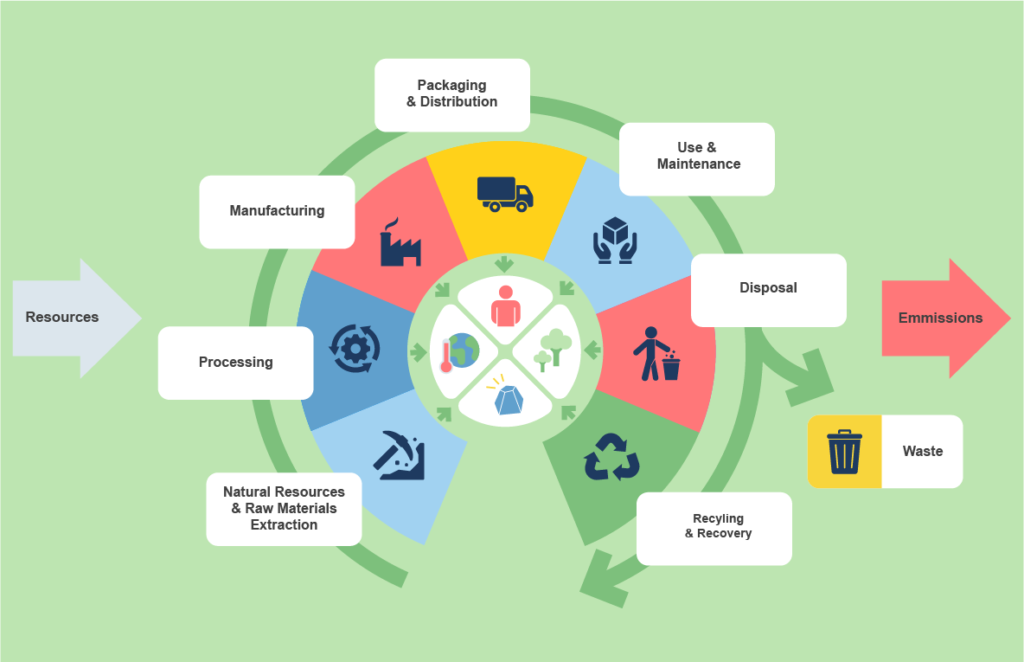
The PEFCR evaluates the entire life cycle (cradle-to-grave) of pet food, including:
✔ Ingredients sourcing
✔ Packaging production
✔ Pet food manufacturing
✔ Distribution
✔ Use phase
✔ Packaging end-of-life (EOL) disposal
Using the PEFCR
When is its use required?
Compliance with the PEFCR is mandatory whenever the results of a PEF study, or any of its content, are intended to be communicated. For in-house applications, such as product development or identifying environmental hotspots, it is optional.
What does it specify?
- Data requirements: which processes require company-specific (primary) data and where secondary data may be used.
- Data quality: minimum requirements for the accuracy and representativeness of data.
- Allocation rules: how impacts are distributed between co-products and processes.
- Impact categories: which environmental impact categories must be reported.
- Modelling: emission factors and process modelling rules.
Verification and comparisons
Verification of a PEF study carried out under this PEFCR follows the general requirements of Section 8 of the PEF method (Recommendation (EU) 2021/2279) and the additional requirements in Section 8 of the PEFCR. Comparisons and comparative assertions are only possible between products of the same sub-category; wet and dry products, and cat and dog products, are not compared with each other.
Datasets during the transition period
Until the next EF database is in place, the availability of EF-compliant secondary datasets is limited. The European Commission guidance of May 2026 sets out how PEF studies can continue in the meantime:
- EF-compliant datasets should still be used wherever they are available.
- Where they are not available, they may be replaced by Entry Level ILCD-compliant datasets, preferably from a single unit process-based database.
- Replacement datasets must be reported clearly in the EF report, together with a disclaimer that their use may affect the comparability of results.
Where no replacement datasets are specified for this PEFCR, users select the relevant Entry Level ILCD-compliant datasets themselves, subject to clear reporting in the EF report and validation by the verifier.
Background and timeline
- 2013–2018 – EF pilot phase. The pet food sector is one of eleven sectors selected; the European Commission supports the pet food pilot from May 2014.
- 2018 – First PEFCR for Pet Food published.
- December 2021 – Commission Recommendation (EU) 2021/2279 on the use of the Environmental Footprint methods published, incorporating the learnings of the pilot phase.
- December 2024 – Positive opinion of the EF Steering Committee on the updated PEFCR.
- February 2025 – Updated PEFCR for Pet Food published.
- May 2026 – Commission guidance extends PEFCR validity until the next EF database is in place.
- 2028 (expected) – Next EF database in place.
Documents and resources
- PEFCR for Pet Food – February 2025 update (PDF, 2.1 MB)
- Available on request from fediaf@fediaf.org: the review comments overview (Annex III), the life cycle inventory data (Annex IV) and the representative product models
- European Commission – Environmental Footprint methods
- Related FEDIAF pages: PEF & Green Claims · Packaging
Frequently asked questions
Yes. In accordance with the European Commission guidance of May 2026, its validity is extended until the next EF database is in place, currently expected in 2028.
The PEFCR is the reference method for PEF studies on pet food whose results are communicated publicly. Any claim based on those results must also comply with applicable EU and national consumer law, including the Unfair Commercial Practices Directive as amended by Directive (EU) 2024/825.
Use EF-compliant datasets where available. Otherwise, follow the approach described under Datasets during the transition period.
No. The PEFCR covers complete prepared pet food for cats and dogs only. Complementary pet food, including treats, is outside its scope.
fediaf@fediaf.org